
Inclusive ads are affecting consumer behavior, according to new research
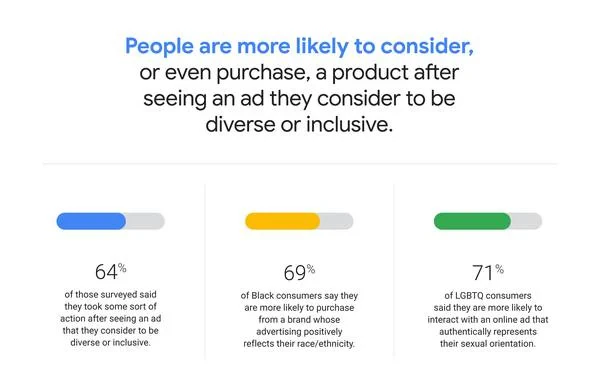
The Female Quotient partnered with Google and Ipsos this past summer to survey nearly 3,000 U.S. consumers from various backgrounds to understand perceptions surrounding diversity and inclusion in advertising.
The research team asked respondents about the factors they considered important for a brand’s advertising campaign to be viewed as diverse or inclusive. The survey covered 12 categories: gender identity, age, body type, race/ethnicity, culture, sexual orientation, skin tone, language, religious/spiritual affiliation, physical ability, socio-economic status and overall appearance.
Diverse and inclusive advertising influences consumer actions
The study found that people are more likely to consider or purchase a product after seeing an advertisement they perceive as diverse or inclusive. In fact, 64% of respondents said they took some form of action after seeing an advertisement they considered diverse or inclusive.
The eight product-related actions respondents could select were:
– Bought or planned to buy the product or service
– Considered the product or service
– Looked for more information about the product or service
– Compared prices for the product or service
– Asked friends or family about the product or service
– Looked for ratings and reviews of the product or service
– Visited the brand’s website or social media page
– Visited a website, application or store to explore the product
Consumers expect brands to reflect the reality of their lives
Consumers expect brands to be inclusive and reflect the reality of their lives through advertising.
Among the various groups surveyed, LGBTQ and Black respondents expressed the strongest preference for diverse and inclusive advertising. For example, 69% of Black consumers said they were more likely to purchase from a brand whose advertising positively represented their race or ethnicity.
“We now have generations of consumers who are increasingly multicultural through the intersectionality of race, gender, ethnicity and sexual orientation. This study clearly told us that these consumers expect brands to be inclusive and reflect the reality of their lives in advertising,” said Virginia Lennon, Ipsos Senior Vice President of the Multicultural Center for Excellence and one of the study’s lead researchers.
Authenticity is essential in inclusive marketing
Throughout the study, respondents were also asked about their perceptions of authenticity in marketing. The findings showed that 71% of LGBTQ consumers were more likely to interact with an online advertisement that authentically represented their sexual orientation.
“It is not enough to put a rainbow on a product and call it a marketing strategy,” said Sarah Kate Ellis, President and CEO of GLAAD, a nonprofit and leading media organization advocating for the LGBTQ community.
“Brands need to take the initiative to reflect the world we live in by showcasing the wide range of diverse identities within the LGBTQ community. This includes transgender and non-binary people, as well as gay and lesbian parents with children. When a trans woman of color is represented in a commercial or advertisement, it builds understanding and sends a validating message to trans people everywhere.”
Organizations must reflect the markets they seek to reach
“If you seek to enter diverse markets, your organization must become the market you seek,” said Johnson.
“The more cultural distance there is between your team and the market, the less ability you will have to execute effectively. We all have particular biases. That is why culturally competent people must be present in the room and have the authority to influence decisions.”
“By bringing in the talents of people who have traditionally been overlooked, you unlock genuine creative expression and build an organization capable of identifying and addressing its own biases.”
The Female Quotient, a women-owned business committed to advancing equality, shared the results of this study to provide a clearer understanding of how inclusive marketing influences consumer behavior.
