What are factors influencing players’ gaming motivation potentially?

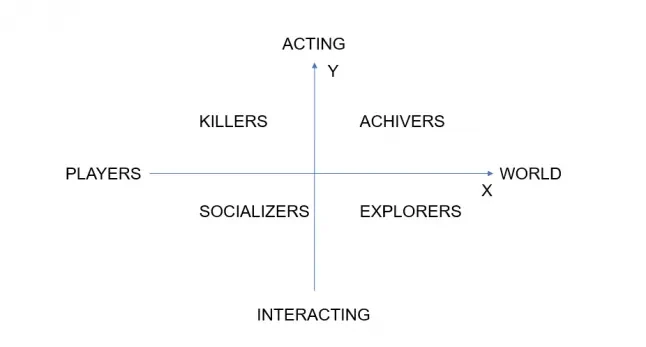
Many researchers and scholars have explored how players' gaming motivation affects their gaming behavior, and have classified players into different types based on their behavior. Probably the most well-known of these is Bartle's Taxonomy of player types, which classifies players into different types, that is Killers, Achievers, Explorers, and Socializers, from four dimensions.
The X-axis represents a preference for interacting with other players vs. exploring the world, differing in what objects in the game the players focus on, and the Y-axis represents a preference for interaction vs. unilateral action, differing in the gaming way. Simply put, killers like competition with other players, and they are keen on defeating others; achievers like to take action against the world and achieve rewards, and they are happy to complete various tasks and goals in the game; socializers like to interact with other players, they are even more interested in game players than the game itself; explorers like to immerse themselves in the game world explorations, they are happy to explore various contents of the game.
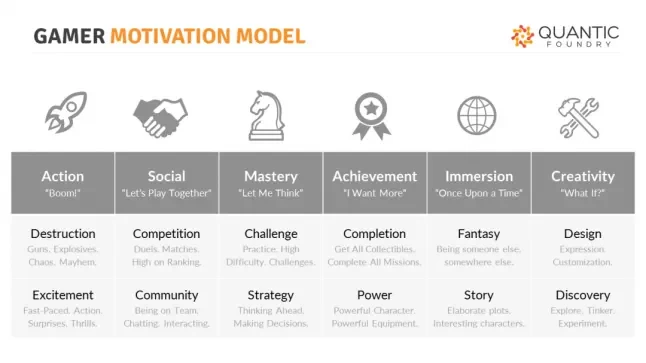
Quantic has done research on what motivates players and through their research, they have uncovered 12 motivations that broadly cover the reasons why people play games based on clustering analysis. They have paired them up into 6 key pairs of action, social, mastery, achievement, immersion, and creativity, which we won't explore in this article.
All of these models effectively help us to understand players from the perspective of the demand, from which we can know better which specific in-game demands influence players' behavior in playing the game, i.e. what players actually want to do in games.
In actual research projects, we discovered that players' needs are influenced not only by in-game factors but also by many other factors outside of the game. If we go one step further and take games as a kind of general entertainment activity and think about why players play games, we will find some interesting points, for example, some players who choose to play games are not necessarily the real gamers. Some out-of-game factors that are often overlooked also influence players' motivation to play, including their life situation and their attitudes and notions about the game.
We found that some of the players choose to play games out of their genuine love, they believe that games give more meaning to their lives and are the best way to mobilize their energy. Accordingly, they tend to have their own clear preferences and attitudes when selecting games, and their behavior is more consistent, so we can easily put these players in one of the categories in the above model.
While some players see video games as a spice of life, for them playing games is not different from watching movies and any other entertainment activities, which are mainly to relax. This type of casual player tends to pay more attention to the visual effects of games and the excitement brought by games, but does not necessarily have high requirements for the gameplay itself. They are also relatively more susceptible to life changes, for example, they may suddenly leave the game when they are busy recently, and may return to it for no specific reasons.
There is another part of players who seem to have complex gaming experiences and seem to be very in-depth in terms of gaming time, but once asking them in detail, you get the feeling that they do not have a clear gaming preference and unlike a real gamer in terms of gameplay understanding. They are always inconsistent in what they say and what they do, so it is hard to classify them as any type in the player models mentioned above.
These players are likely to be gamers who see gaming as a social activity, who play games mainly influenced by their friends around them, and are trying not to be left behind by the people. They focus on playing with friends, not the game itself. It is easy to understand why they often choose very different games; if we look too deeply into their evaluation of a game, we will probably end up finding nothing insightful at last.
The MMO game player I mentioned above represents a group of players, who are eager to escape from daily life. They may have the need to relieve the stress, and an interesting game environment and low threshold to start can easily attract them; they may also have unique emotional needs, desire to find a social connection in the game, or find their lost selves, and thus they will value whether the game is humane, rather than whether the game quality is high or not.