When discussing a “Smart City”, many people often think of a city filled with advanced technologies such as AI, IoT, or automation systems, causing the term to be associated primarily with modernity. However, the core essence of a smart city does not lie in technological advancement or the increasing volume of technology usage, but in the important question of whether that city can genuinely improve people’s quality of life. ROCTEC is one of the key players helping turn the city’s digital infrastructure and the improvement of people’s lives into reality.
At the global level, the smart city trend is not merely a concept, but is reflected in clearly growing investment. The market value stood at approximately USD 877.6 billion in 2024 and is expected to expand to USD 3.76 trillion by 2030, or more than THB 122 trillion, equivalent to six times of Thailand’s GDP. Additionally, Asia Pacific is one of the fastest-growing regions, supported by urbanization, government policies, and the serious adoption of technologies such as AI and IoT. For Thailand, smart city development is currently still in its early stage, but is likely to grow rapidly, as seen in real-time train arrival displays, automatic license plate recognition systems, screens showing traffic density on various roads, intelligent traffic light systems, and PM2.5 monitoring devices in public parks.This makes the current period an important moment to lay the foundation for digital infrastructure, as players that position themselves from the early stage will have the opportunity to grow alongside the future expansion of the market.
Within the components of a smart city, the “Transportation System” is an important starting point as it is part of people’s daily lives and has a direct impact on time, quality of life, and economic efficiency. Bangkok is a clear example that reflects the “real cost” of this issue. People lost as much as 115 hours to traffic congestion per year in 2025, which not only affected quality of life but also created a broad economic burden. This reflects that an inefficient transportation system can undermine both confidence and opportunities for urban development.
In the other side, Hong Kong presents an interesting example through its MTR system, which serves more than 5 million passengers per day, more than three times of Thailand’s scale, where daily ridership stands at 2 million. with punctuality as high as 99.9%. This shows that if a transport system is efficient, a city can move smoothly, people can plan their lives effectively, and economic activities can continue without interruption. Ultimately, the difference between cities lies in the quality of their systems and the level of investment in infrastructure.
The gap between Bangkok and Hong Kong therefore does not lie in the size of the city, but in the intelligence of its smart systems, data connectivity, and continuity of investment. This represents an opportunity for technology providers to help elevate the city.
However, physical infrastructure alone may not be sufficient for the modern city, as the key lies in “Digital Infrastructure,” which connects, controls, and manages various systems, whether train operations, real-time monitoring, or safety. Although it may not be clearly visible to users, digital infrastructure plays an important role in the stability, safety, and continuity of service delivery.
From this perspective, ROCTEC’s role is notable as one of the important contributors behind the city’s digital infrastructure, particularly in rail and electric train systems, which are comparable to the main arteries of travel in large cities. Although this role may not be visible to passengers in daily life, these behind-the-scenes systems are important mechanisms that help ensure continuous and stable service delivery and support user safety.
ROCTEC is not merely a technology system integrator but plays a role that covers critical rail system infrastructure, from railway communication systems such as train control systems, CCTV and smart security systems, air quality monitoring devices, and smart building systems all of which help make train operations safer, more connected, and more punctual. At the same time, ROCTEC is expanding into IoT and predictive maintenance to forecast and prevent disruptions in advance, as well as cybersecurity and digital display & urban communication solutions that help make urban information communication more efficient. All of this reflects that ROCTEC is not merely a behind-the-scenes player, but a company that connects the city’s transportation, data, and communication systems in an integrated manner.
At the same time, in the smart city dimension, digital infrastructure is not limited to transportation systems, but also covers the “City Communication System.” In an era where people live in both the physical and digital worlds, communication must be able to reach people in a way that aligns with real-life contexts. The digital media business is therefore not merely advertising, but part of the city’s communication ecosystem, helping information and news reach people efficiently at the places where they actually live their lives.
For Thailand, this trend is also becoming increasingly important. As transportation systems and various forms of infrastructure become more connected, residents seeking future housing will not consider only location or building design, but also the ability to connect their own lifestyles to the city conveniently and safely, as well as the availability of technology that meets the needs of daily life. In late 2026, ROCTEC will begin to play a role in another dimension of this development together with BTSG, by further leveraging ROCTEC’s in-house R&D expertise. This reflects a more concrete extension from Smart Mobility to Smart Living.
Ultimately, a true smart city may not mean a city with a large amount of advanced technology, but rather a city that allows people to clearly feel that “life has truly improved” in every dimension. This ranges from a reliable transportation system that makes people feel safe, to an efficient and accessible city communication system, and to homes and living environments that can connect seamlessly with people’s lifestyles.
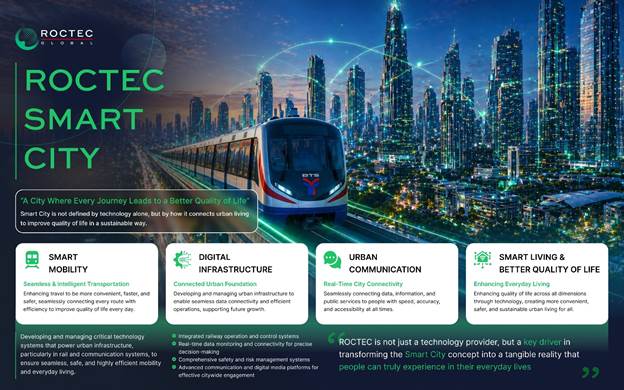
ROCTEC views a smart city as an interconnected “Urban Ecosystem,” ranging from Smart ICT and digital infrastructure, which serve as the data foundation, to Smart Mobility, which enhances travel to be efficient and seamless.
This concept extends to Smart Building and Smart Living to improve residential quality, alongside Smart Grid and Smart Environment, which support energy management and long-term sustainability. Together, these elements not only drive the city structurally, but also tangibly improve people’s quality of life.
Therefore, if a smart city is a picture of the future, ROCTEC aims to be one of the key driving forces that gradually and systematically turns that future into reality through the development of solutions that can connect efficiently and build on technological expertise to create value that people can experience in daily life.
With this vision, ROCTEC aims to be one of the key drivers through the development of efficiently connected solutions and the extension of technology into value that people can truly experience. Ultimately, a good city may not be the city with the most technology, but the city that uses technology appropriately and meets people’s needs in life. This is the direction that ROCTEC is committed to driving continuously.
For further information, please contact:
Investor Relations Department, ROCTEC Global Public Company Limited
Tel: +66 2-080-1000 ext. 6013 | Email: ir@roctecglobal.co.th