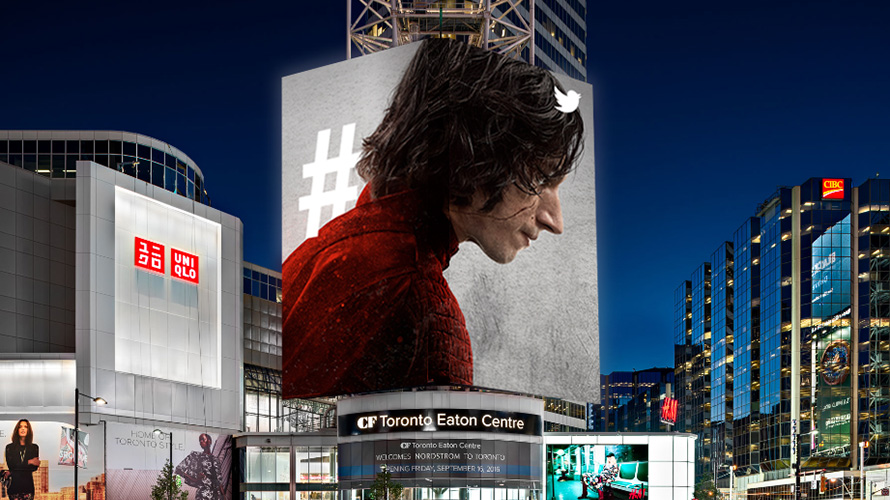
“If the past few months are any indication, we have seen a dramatic increase in experiential and out-of-home,” said Nola Weinstein, global head of culture, engagement and experiential marketing for Twitter. “I think you can expect to see more and more of this kind of work [from us].”
So far this year, Twitter has increased its out-of-home spend by 50% year over year. The company did not provide figures of comparison of its 2018 OOH spent to its 2019 OOH spend. As for experiential, earlier this summer, the company put together its first global experiential activation, #TweetUps, in 40 locations across the globe including cities like New York, London, Tokyo and Los Angeles.
Much like digitally native brands, platforms with a primarily digital presence are increasingly looking to get consumer attention offline. As the OAAA reported earlier this summer, OOH advertising increased by 7.7% in the second quarter of this year — the highest quarterly growth in a decade — and over a quarter of the top 100 brands that increased OOH spending were tech brands. As for experiential, an AgencyEA study found that 92% of brands who responded believed that experiential was key to growing sales and 67% of B2B marketers planned to increase experiential this year, per Campaign. “To win, you have to connect with consumers on an emotional level. Experiential work is a way to organically make human, emotional connections,” said K.J. Ho, vp and business director at Optimist. “This task is especially important for brands like Twitter that are trying to create brand affinity and are aiming to take their presence from the digital world to the physical world.”
In the first half of 2019, Twitter spent $9.5 million in media, up slightly from the $8.8 million it spent during the same time period last year, according to Kantar. Throughout the full year of 2018, Twitter spent $15.8 million, up from its $9.2 million spend over the course of 2017, per Kantar, which doesn’t track social spending. Part of the brand’s strategy is to create events or use OOH work inspired by what people who use Twitter are already doing, e.g., the #TweetUp events or the “Me on Twitter” campaign, that would naturally get consumers talking and engaging online, especially on Twitter.
Weinstein said. “Our users are reflecting what they see in the wild. And over the course of campaigns like this, they’re seeing tweets and they’re amplifying it on the platform. They’re amplifying on other platforms or sharing it with their friends and that further drives conversation.”
“I think rather than us as a brand creating ads where we tell you what’s with Twitter is authoritative, we recognize that over the years people who use Twitter have already been doing that,” said Weinstein. “They participated in memes and they’ve freely shared what they think Twitter is. They’ve already articulated what Twitter is to them.”
source : https://digiday.com