A solid customer experience strategy might just be the difference between your brand and your closest competitor in 2020. In fact, Gartner reports that 81% of executives believe they’ll compete on customer experience alone in the not-too-distant future, but only 22% have claimed to have developed an experience that exceeds customer expectations.
As brands look to close this worryingly wide gap in 2020, we take a look at key digital customer experience trends that every ambitious brand should know about.
Here are the top 5 digital customer experience trends you need to look out for in 2020
- 1. AI will develop within the customer service space
- 2. Voice commerce will come of age
- 3. Customers will expect hyper-personalized experiences
- 4. Increase emphasis on the employee experience
- 5. More bots to assist both business and consumers
1. AI will develop within the customer service space
.png)
According to Conversocial, nearly 66% of customers switch brands because they’ve experienced poor customer service.
The IoT-era, with its smart speakers and intelligent refrigerators, has brought us a hyper-connected world of real-time experiences and instantaneous responsive feedback. Plus, with 5G on the way, you can expect consumers to expect things even faster before the end of 2020.
Expect more brands to utilize social messaging alongside AI and chatbots in 2020 to help plug this speed gap. Social messaging, like Facebook Messenger and Twitter, is ushering a new generation of customers who expect more and want things to be done fast. In addition, social messaging merges all the best elements of traditional digital customer service channels including full chat functionality, persistent consumer identity, and mobile notifications.
And by combining both AI and chatbot technology with social messaging, brands will be able to automate and personalize their responses.
How to leverage this digital customer experience trend: Experiment with emerging technologies such as digital signage, smart speakers, and wearables
The modern consumer is looking for new ways to be impressed — not with gimmicks, but with convenience.
Technologies like smart speakers, digital signage, VR, beacons, and wearable devices all provide unique opportunities to surprise and delight consumers with AI-enabled experiences in-store, and even in their own homes and vehicles.
2. Voice commerce will come of age
.png)
Voice assistant technology is already showing strong rates of adoption. The Amazon Alexa Skills marketplace has over 50,000 skills worldwide (as of September 2018), which is a steep jump from the 30,000 milestone that was achieved in March, earlier this year.
Along with this rapid adoption of voice-activated speakers, we have also seen a drastic change in consumer behavior. Think with Google states that 72% of people who own a voice-activated speaker say that their devices are used as part of their daily routine.
Already, we have seen a number of eCommerce brands sell their products or service through voice commerce, but we expect this trend to continue to rise in 2020. According to OC & C, voice commerce sales in the US are expected to reach $40 billion in 2022, up from $1.8 billion in 2017.
.png)
To keep up with this trend, brands will need to invest in a headless commerce solution to make their products and shopping experiences available on a broader range of platforms; from voice-enabled speakers to kiosk screens and everything in between.
With a headless commerce solution, brands can develop eCommerce experiences on a range of devices—including smart speakers like the Amazon Echo.
Alexa Skills development platform Blutag has been pretty popular with eCommerce brands since it provides simple integration with existing eCommerce and retail platforms and a no code development environment. It also provides the ability to create actions for Google Home.
When developing your Alexa Skill for your eCommerce site, do make sure you incorporate natural language. For example, when a consumer wants to shop around for a pair of running shoes, they may say, “I am looking for a pair of black running shoes”. It is really important that you incorporate how your consumers will interact with your brand through voice.
3. Customers will expect hyper-personalized experiences
In a report by Internet Retailing, 69% of consumers want to have a personalized experience, yet less than 50% of brands are actually delivering.
Consumers have now become used to brands reaching out to them in personal ways. This includes personalized emails and newsletters and product recommendations that have been formulated from the consumer’s previous purchases. Customers love this kind of service because they’re getting what they want without having to say a word.
As more IoT devices become available, brands will have access to more in-depth data about their customers than ever before. They can leverage this data to identify the customer’s pain points, buying habits, and interactions they had with agents from the past to deliver a highly personalized service
How to leverage this digital customer experience trend: Personalize the customer experience based on user behavior
Hyper-personalization can only be achieved if you have access to in-depth data about your consumers. By using a DXP solution like Core dna, you will have the ability to track and collate your user activity across every touchpoint and device, enabling you to know what content they viewed, their purchase history, and more. Using this information, you can deliver more relevant and highly personalized campaigns.
Additionally, Core dna also lets you segment your contact database, via integrating your favorite CRM tool, into various personas so you easily tailor content for each group.
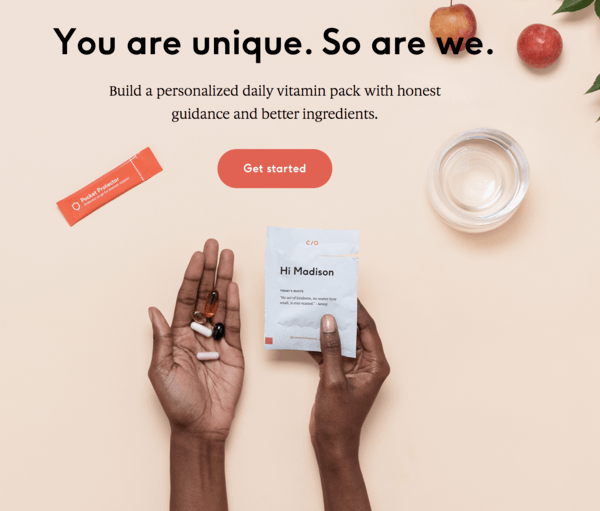
New York-based Care/of truly acknowledges the customers’ demand for personalization. The supplement brand developed their entire business model around it. Care/of delivers their customers a tailor-made box of daily vitamin supplements.
Customers are asked a series of questions based on their lifestyle, diet, and goals. Once they have completed the set of questions, they are given a personalized recommendation of daily supplements to take while providing the option to adjust the quantity as they please.
This type of personalization is quite unique since Care/of has simplified a tedious process of meeting the individual customer’s needs. And also, with each interaction, Care/of attained deeper insights which will help them improve their marketing strategies and retain their customers.
4. Increase emphasis on the employee experience

Numerous research studies show a strong correlation between employee experience and customer experience. One study highlights that companies with highly engaged employees outperform their competitors by 147%.
In 2020, expect to see an emphasis on brands deploying intranets and extranets, surveying employee satisfaction, introducing incentives, and more—especially in a customer service environment. By offering staff a tangible bonus in exchange for achieving positive results will help to boost customer retention.
How to leverage this digital customer experience trend: Evaluate your employee experience
The best way to deliver a better experience to your employees is to create an employee experience portal, which is essentially an intranet system based on a decoupled headless architecture. This will enable your brand to deliver personalized messages to your employees across a multitude of devices which will help improve employee engagement.
The makers of Cheerios, General Mills, began modernizing their employee experience with a focus on creating consistency for their 38,000+ workforce scattered across 30 countries. The firm developed an online portal called G&Me which provided staff self-service access to HR, payroll, and more.
5. More bots to assist both business and consumers
.png)
Besides providing speedy responses, chatbots have been proven to be an amazing virtual assistant for businesses. They help to deliver product information to your customers when no human agents are available. And thanks to recent developments in AI technology, some chatbots can now hold an engaging conversation without being awkward.
How to leverage this digital customer experience trend: Use chatbots to drive conversions
Luckily, there are plenty of chatbot builders that allow non-techs to create their own chatbots with little or no technical expertise. Chatbot builders like Activechat.ai, Drift, and Intercom all come with a user-friendly interface and pre-built templates to enable users to create their own chatbot experiences to which they can integrate with their preferred social messaging solution, mobile app or website. Many chatbot builders come with AI and machine learning technologies to help brands automatically deliver the most appropriate response based on the analysis of user intent and emotion.
Besides Accenture, Filipino-based telecom giant Globe Telecom utilized a chatbot for Facebook Messenger in an effort to better connect with their 62+ million customers. On using the chatbot, they saw their customer satisfaction rate increase by 22%, and saw their employee productivity increase by 3.5x.
Source : https://www.coredna.com/blogs/digital-customer-experience-trends