Every marketer and their mother is talking about how awesome influencer marketing is — and they are not wrong. Even though influencer marketing has been repeatedly included in the "20xx trends" for at least the last ten years, it is there for a reason.
This strategy had some changes over time, but it still remains one of the most effective digital marketing strategies out there. According to the 2020 survey conducted by the Influencer Marketing Hub, 49% of consumers depend on influencer recommendations. Perhaps that's why 91% of the survey respondents believe influencer marketing to be an effective form of marketing.
However, as I mentioned before, there have been a lot of changes introduced to the way we carry out influencer marketing campaigns. Can you be sure that your influencer marketing strategy is not outdated?
You can with this article! We gathered the most up-to-date influencer marketing tips to show what you should and shouldn't do in 2021. This advice is based on influencer marketing trends that we could observe in 2020. So let's refresh your influencer marketing strategy according to influencer marketing 2021 trends.
Tip 1: Work with micro-influencers
For newbie marketers, the more followers an influencer has, the more leads their campaign will generate, right? Wrong! The biggest mistake a marketer can make is to go chasing follower numbers. A study by Expert found out that 82% of consumers are “highly likely” to follow a recommendation made by a micro-influencer.
Oftentimes, micro-influencers are focusing on a specific niche: they can talk about growing plants, reading Tarot cards, reviewing different bikes, and so on. This helps you choose an influencer whose followers are certainly in your target audience. Laser-focused marketing is the best kind of marketing!
Another advantage of micro-influencers is the relationships with their audience. Due to the size of their following, they are able to build a more genuine and authentic connection with their followers, and thus, people trust their recommendations much more than those of a macro-influencer.
For these reasons, it might be more beneficial for your brand to contact a smaller influencer for an influencer marketing campaign.
Tip 2: Pay attention to analytics
As we learned, marketers are convinced that influencer marketing works. But it's not enough to believe that it works, in the marketing world, data is everything and you need to back up your beliefs with robust analytics.
When you set up an influencer campaign, it's most likely you check the number of clicks and purchases from links you provide the influencer with. Many marketers stop at that. However, this is not enough.
It's becoming more and more common to ask influencers for deeper analytics such as:
– The number of views or impressions
– Engagement rate
– New followers
– and so on.
– Engagement rate
– New followers
– and so on.
You can also use social listening to check how much buzz your campaign generated and among which demographics it was more popular.
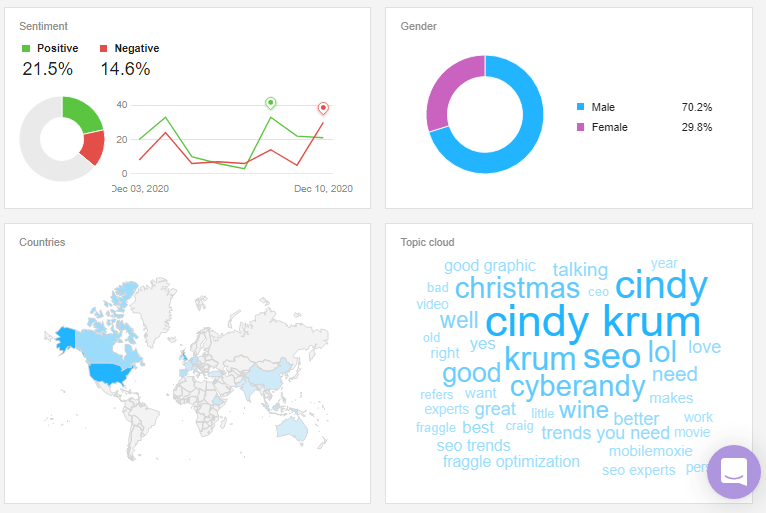
Here's an example of social listening analytics from Awario's dashboard for Cindy Krum, an SEO influencer.
Tip 3: Get creative with influencer campaigns
In 2020 and especially 2021 it's no longer enough to post a picture of a product and say you like it to convince people to buy it. Both brands and influencers are getting more creative with their influencer campaigns and using different mediums, formats, and types of content to convert consumers.
Take a look at this paid partnership post by Hannah Witton. The Old Vic theatre partnered with Hannah to promote their online Christmas performances and asked her to play Jingle Bells with the handbells they've sent her. They partnered with her for several reasons: she lives in London and The Old Vic is a London theatre, she loves theatre and musicals, and she has a bubbly charming personality perfect for this kind of a challenge. Thus, she matches their target audience great!
This campaign is a perfect example of creative influencer marketing. Don't just give your influencers a short pitch with a product description and call it a day. Use your imagination!
Tip 4 : Say yes to long-term partnerships
More and more brands are prioritizing long-term relationships with influencers over one-time collaborations. For example, in the make-up world brands create PR lists with trusted influencers and send them every new product they launch, invite them for their events (in pre-COVID times obviously), take them on trips, invite them to host their online streams, and so on.
Of course, building relationships requires more effort than collaborating on one social media post, but the ROI can be incredible. The audience of the influencer is getting reminded of your brand more and more often and thus becomes more and more interested in it. Besides, long-term collaboration is a sign of a brand's quality: you wouldn't use a product more than one time if it was a bad product or service.
For example, this influencer has been partnering with Glossier for the last 3 years and many of her followers learned about the brand through her videos.
Tip 5: Invite influencers to host virtual events
Speaking about online streams, with everyone locked inside to stop the spread of COVID-19, online events are more popular than ever. An online event doesn't have to be a huge deal like an awards show or something like that, it can be just a live-stream on Instagram, a Q&A session, or something else as easily produced.
This tactic was successfully used by Joe Biden during his presidential campaign. The future president invited influencers from different niches, from young women rights activists to mommy bloggers, and they interviewed him on their topic of interest. The interviews were streamed on Twitch, YouTube, and Instagram.
It would be presumptuous to say that influencer marketing helped Joe Biden win the elections but it certainly worked. All the more reasons to try it yourself!