
What Is the Customer Journey?
The customer journey is the decision-making process someone goes through to buy something. The starting point for this process is unique to each consumer. But the destination is the same as a purchase. In this article, you will discover how the Customer Journey works and how to leverage it to make more sales.
How Buyers Progress Through the Customer Journey
The customer journey may take place for a few minutes or many years. The timeframe is usually much longer for higher-priced or complex products and services. Each buyer enters the journey at a specific point based on many unique factors.
As one example, some consumers may know a lot about your product or service. But people who do not will have to spend some time learning about it. This factor alone changes the customer journey dynamic.
Stages of the Customer Journey
The customer journey can be broken down into stages. Each stage represents where someone is in the decision-making process. I will go into more detail about each stage in the sections that follow.
How many stages of the customer journey there are varies with the source of reference? I have broken the process down into five stages, as shown in the image below.
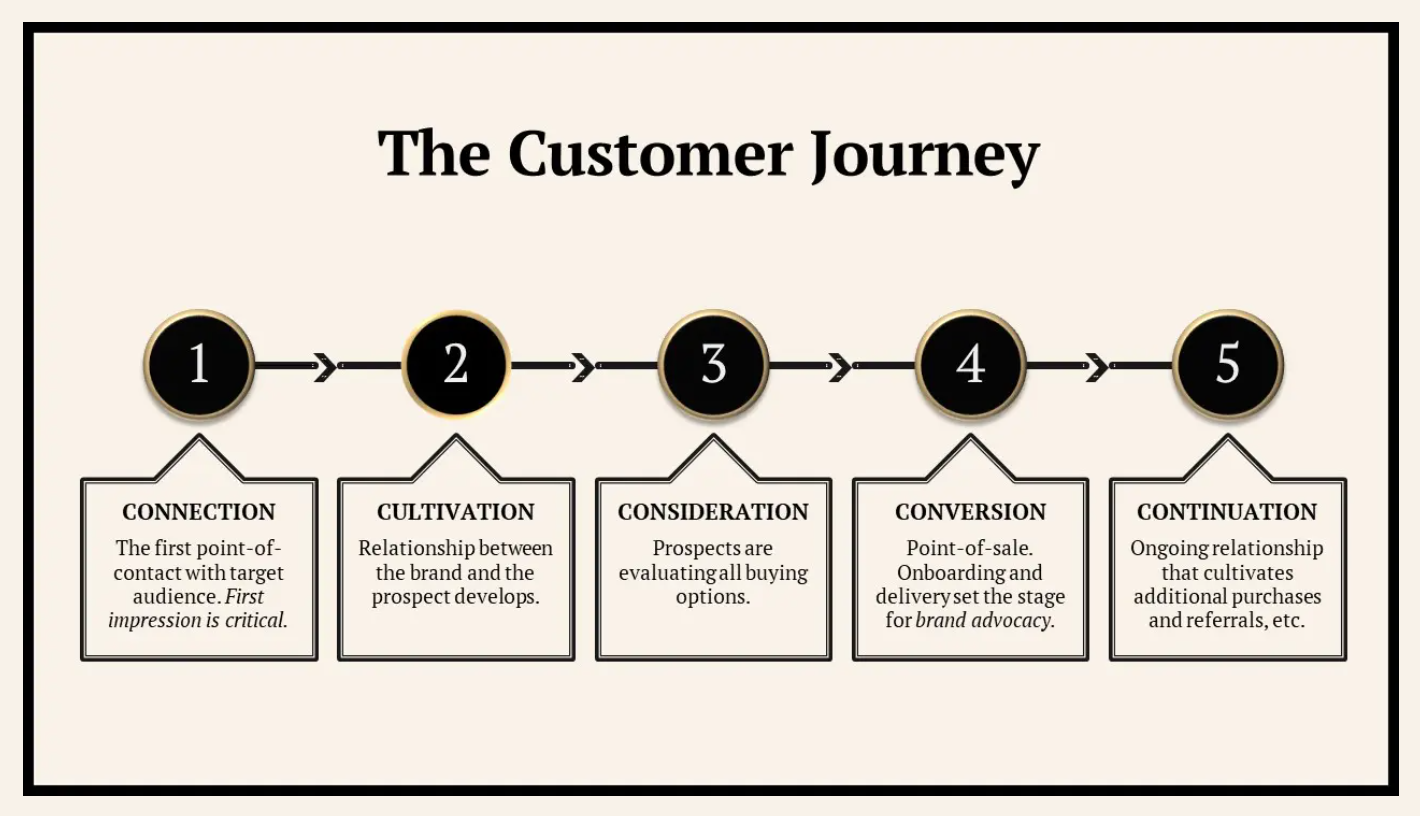
We need a plan for each stage of the customer journey. This helps us meet prospects where they are in the buying decision. This plan will also help you capitalize on every opportunity to get customers.
Customer Journey Stage 1: Connection
This is the first stage of the customer journey, also known as the “awareness” stage. Prospects in this group find your business through a variety of sources. Social media, ads, or word-of-mouth are a few examples.
These prospective buyers do not know anything about you. It is your responsibility to educate them on what you do and how you do it. The goal is to build more interest in your brand and show prospects how you can help them.
When deciding which audiences to target, look for people who are the best fit for your product or service. This will help you focus only on those who have a higher degree of buyer intent.
What Is Buyer Intent?
Buyer intent gauges how serious someone is about purchasing your product or service. The more interested they are the better, but not everyone who shows interest will buy. That is why it’s best to qualify prospects during this first stage.
Some people may be interested enough in what you do to “check it out”. But that does not mean they’re a true potential customer.
To qualify your audience, separate them by degrees of intent—low, moderate, and high. Start with the highest and figure out what you could do that might entice them to buy. Some things these people may want to know are:
– Is a free trial available?
– What versions are available and what sets them apart?
– Where are reviews?
People with moderate interest need more evidence to confirm their decision to buy. Examples of questions they have are:
– How are you unique?
– Do you have case studies, white papers, and testimonials?
– Does the value of features and benefits outweigh the price?
People with low buyer intent may not be a good fit at all. But there is also a chance they might be a customer once they understand how you can help them. Creating a link between their problem and your solution will help you overcome this barrier.
Of all five stages, the connection stage is the most critical. Why? Because it is here that you make your first impression.
You have got to make your best first impression right away or you won’t get another chance. A strong brand makes your business look more professional. It also increases the perceived value of your products and services.
Customer Journey Stage 2: Cultivation
So, what happens when you connect with a prospect, but they aren’t ready to buy?
Move on to the Cultivation stage.
Cultivation is exactly that. From the moment you connect with a prospect until the day they buy (or decide they never will), you will keep in touch.
For that to happen, you need an experience that keeps them engaged. This may be the most challenging stage of the customer journey. Keeping people interested especially in an era of two-second attention spans is far from easy. Many businesses struggle with Cultivation because they go about it the wrong way.
Too many of them are using tactics that do not align with their strengths. As a result, they end up spending a lot of time and money on marketing tactics that do not work.
So, what is the solution?
To find out, answer these questions:
– What type of business promotion do you enjoy most?
– What are you good at doing that you can leverage to promote your business?
– How often are you willing to do it? Daily? Once a week?
Rather than forcing yourself to do things you don’t like or aren’t good at doing, find what works for you. Then, stay with it. Consistency is key.
Customer Journey Stage 3: Consideration
The importance of this stage is often understated. Prospects in this phase are serious about buying your product or service.
Why?
Because they are not sure if your product or service is the solution they are looking for. That is why you must provide proof beyond a reasonable doubt that what you offer is exactly what they need. You must show them that it is better than the alternatives. People in this stage of the customer journey are looking for the right brand signals. These signals tell them which business is most qualified to give them what they want.
If people want to buy but do not, it’s probably because you aren’t sending the right brand signals. The company that does will get the sale.
This is where the essence of a powerful brand pays off. A brand strategy will help you learn which signals prospects are looking for and how to communicate them.
Customer Journey Stage 4: Conversion
This is where the fun begins. In this stage of the customer journey, the prospect finally becomes a customer. Now, you have got to deliver on the promises you have been making in the previous stages.
Inconsistent service and quality will destroy any credibility you have built in previous stages of the customer journey. To avoid making this mistake, be sure your marketing, advertising, sales, and service processes align.
Staying “on brand” in all stages of the customer journey is the key to getting five-star reviews. And many of those happy customers will become advocates for your brand by telling everyone they know about you. This is the best version of free advertising you could hope for.
Customer Journey Stage 5: Continuation
In this final stage, your customers are buying from you again and again. They think you are great and want to stay with you forever. Many of them have become brand advocates.
Reselling to a current customer is easier than finding a new one. Keep in touch with your customers without being obnoxious, of course. Be sure to stay relevant so you can continue to meet their needs.
Surveys and feedback are invaluable resources that will help you stay current. The information you receive will help you understand how your customers’ lives are changing. It will also reveal new opportunities to solve new problems they are having.
Source: https://www.goldenvineyardbranding.com/blog/stages-of-the-customer-journey/